How Traders Turn Meme Coin Bets Into Seven Figures While Surviving the Drawdowns
You can order the same kind of articles for your own video to boost it on YouTube and Google. Just message the Telegram bot @sat_sit_bot. The bot writes and publishes the articles itself (with your YouTube video embedded) on popular topical websites (no ads). Your first 50 articles are free.
· based on the channel Megga
Key takeaways
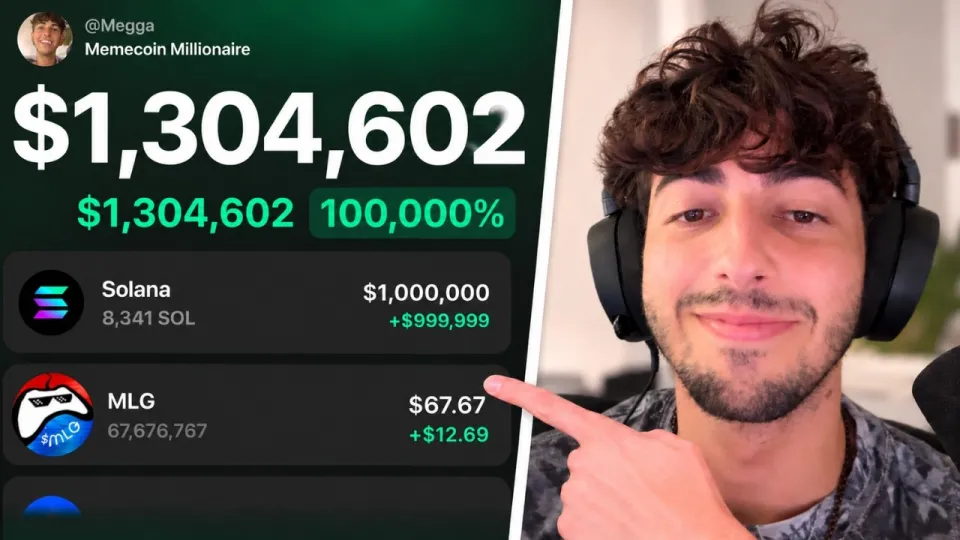
- Megga's breakdown covers a $1,000,000 result from trading memecoins, built on early entries and repeated small bets rather than one lucky ticket.
- Meme coin liquidity is zero-sum: every realized profit is paid by a later buyer, which is why rug pulls and exit liquidity dominate the comments.
- The channel's free course is delivered through Whop, and trading is routed through Padre, a low-fee platform promoted in the video description.
- Viewers report real damage beyond losses: a 200x on $GP was followed by a wallet drained through phishing, wiping out the gains.
- A 9-to-12-hour daily routine only pays off if it is spent on research, on-chain checks and review, not on screen-watching.
Meme coin trading can produce a seven-figure PnL, but the number is the output of a repeatable process: early entries into new launches, strict position sizing, hundreds of small decisions and the ability to keep going after drawdowns. Megga's breakdown of a $1,000,000 run makes the point that the result came from volume of attempts and discipline, not from a single lucky ticket — and the free course behind that workflow is available via the Whop checkout page.
What a seven-figure meme coin PnL actually consists of
A seven-figure result in memecoins is a portfolio outcome, not a trade outcome. It is built from many positions where most are small losses or scratches, a handful are 2x–10x, and one or two are the outliers that pay for everything else. The arithmetic matters more than the story: if you risk 1–3% of a bankroll per idea and one position returns 50x on that slice, the bankroll grows by roughly half to one and a half times — so reaching seven figures requires either a large starting bankroll or the compounding of dozens of such hits.
This is why the traders who last talk about process rather than picks. The work is: find launches early, size so that being wrong ten times in a row is survivable, take partial profits into strength, and cut positions when the thesis breaks. The Fortnite-to-crypto path Megga describes is not a shortcut — it is the same grind applied to a different game, with a much faster scoreboard.
Why memecoins are a zero-sum game and who provides the exit liquidity
Every dollar realized in a memecoin comes from someone who bought later at a higher price. That is the structural truth behind the harshest comments under the video, which accuse the strategy of being a rug pull in disguise. It is not a moral technicality: in a token with no cash flows, no revenue and no buyback, the only exit is another buyer, and the last buyers are the ones holding the bag when liquidity disappears.
This does not make all trading fraudulent, but it does define the risk profile:
- Liquidity is thin and removable. A developer or a large holder can pull pooled liquidity in a single transaction, and the chart goes to zero before anyone can exit.
- Slippage is a hidden tax. On small-cap launches, a market order large enough to matter can move the price several percent against you.
- Narratives decay fast. A meme that works for days can be dead in hours, and the exit door narrows exactly when everyone wants it at once.
- Survivors are selected for speed. Being early is the edge; being early and wrong is the normal case.
Anyone entering this market should assume that a meaningful share of launches are designed to transfer money from late buyers to early ones, and should size accordingly.
The routine behind the results: what 9 to 12 hours a day looks like
Time spent in front of a screen is not the same as work done. When viewers ask what actually fills a 9-to-12-hour day, the honest answer for a profitable memecoin trader is a loop of research, execution and review rather than passive chart-watching:
- Scanning for new launches. Monitoring launchpads, social feeds and wallet trackers for tokens that are early but not obviously dead on arrival.
- On-chain due diligence. Checking holder distribution, whether liquidity is locked, whether top wallets are clustered, and whether the contract has obvious red flags.
- Sizing and entry. Deciding the position size before the entry, not after the price moves, and accepting that most entries will not work.
- Managing the position. Taking partial profits into strength, moving stops, and refusing to average down into a broken chart.
- Review. Logging what worked, what was luck, and which mistakes repeated — this is the step most people skip and the one that compounds.
A full-time schedule only has value if steps 2 and 5 are actually done. Watching candles for twelve hours without a written plan produces the same result as watching them for one.
Learning without a network: how solo traders build an edge
You do not need a group of friends trading alongside you to learn this market, but you do need feedback. Public streams, X timelines, trading communities and recorded sessions all serve the same function as a trading desk: they expose you to how experienced people think about entries, exits and risk in real time. The trap is consuming that content passively — the value comes from comparing your own decisions against theirs on the same setups.
For someone with a modest all-time PnL, the practical path is unglamorous: keep position sizes small enough that a loss does not change your behaviour, track every trade, and ask better-resourced traders specific questions about process rather than for tickers. Networking works when you bring something to the table — a track record, a research habit, or a niche you cover well.
Losses, phishing and the psychology of the drawdown
Drawdowns are part of the model, not evidence that the model is broken. The most instructive story in the comments is not a win but a sequence: a 200x on $GP, followed by a wallet drained through phishing, followed by several more losing positions and a loss of confidence. That pattern is common and it has two causes — operational security and emotional decisions made after a big score.
A few rules follow directly from it:
- Separate wallets. Keep trading capital in a dedicated wallet, never connected to anything holding long-term funds.
- Treat every signature request as a transaction. Phishing drains come from approvals, not from market moves.
- Bank part of outlier wins. A 200x that stays in the same wallet is exposed to both the market and the operator.
- Return to basics after a shock. After a drain or a losing streak, reduce size until decisions are boring again.
The mental side is the harder half. Losing is part of the learning process, but only if the losses are small enough that you keep making the next decision well.
Useful links
- Free course and checkout: https://whop.com/checkout/plan_Jfp7BxTu8pWGu/?session=chs_HL1L0oQ9QcTEa3
- Trading platform with low fees: https://trade.padre.gg/rk/megga
- Twitch: http://www.twitch.tv/megga
- TikTok: https://www.tiktok.com/@meggafaze
- Twitter: https://twitter.com/megga
- Instagram: http://www.instagram.com/fazemegga
Final thoughts on the meme coin game
A seven-figure memecoin result is real and achievable, but it is the visible end of a distribution where most participants lose money and a few lose everything to a rug or a drain. The repeatable parts are unglamorous: early research, small survivable positions, partial profit-taking, secure wallets and a written review of every trade. The channel Megga frames the journey honestly, including the losses and the isolation, which is more useful than a highlight reel of winners. If you want the structured version of that workflow, start with the free course on Whop — and treat every dollar you put into a memecoin as money you can afford to lose entirely.
Questions & answers
How much capital do you need before trading memecoins seriously?
There is no fixed threshold, but the size of your bankroll should determine your position sizes, not the other way around. A trader with roughly $45,000 in all-time PnL can still operate responsibly by risking a small percentage per idea and tracking results. What matters more than the number is whether a losing streak leaves you able to keep making clear decisions.
How do you tell whether a new memecoin narrative will actually run?
You cannot know in advance, so you test cheaply. Look at holder distribution, liquidity lock status, wallet clustering and how early the token is relative to social attention, then take a small position and let the market tell you if the thesis works. Treat every narrative bet as a probability, not a prediction, and size so that being wrong repeatedly is survivable.
Is meme coin trading just taking money from later buyers?
In a token with no cash flows, yes: every realized profit is paid by someone who bought higher and did not exit in time. That is why liquidity, exit timing and position size matter more than the story, and why a large share of launches should be assumed to be designed to transfer money to early holders. Understanding this is a risk-management requirement, not just a moral one.
What should you do after a big win or a wallet drain?
Reduce risk and rebuild the process. Bank part of any outlier gain, move long-term funds into a separate wallet that never signs unknown transactions, and cut position sizes until decisions feel routine again. Most damage after a large win or a phishing loss comes from trying to recover the feeling rather than the money.
Source: How I Made $1,000,000 Trading Memecoins (FULL BREAKDOWN) · Markdown version